
Depression Isn’t Just a Mood Problem. It’s a Circuit Problem.
Transcranial Magnetic Stimulation, or TMS, uses targeted magnetic pulses to stimulate underactive brain circuits involved in mood regulation. For patients who have not found adequate relief with medication alone, TMS offers a non-invasive, FDA-cleared treatment option that works at the level of brain networks — without anesthesia, without systemic medication side effects, and without downtime.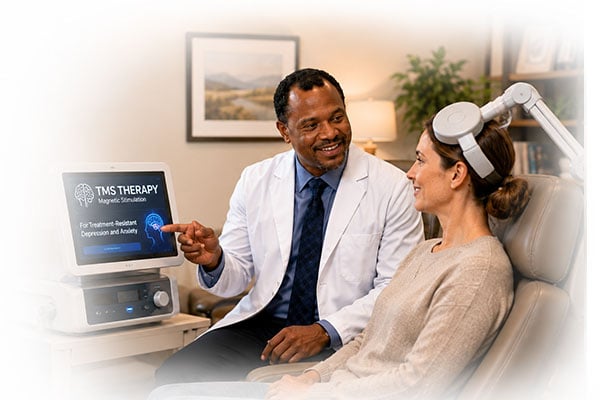
Helping the brain restore healthier communication patterns
TMS is a non-invasive neuromodulation therapy that uses magnetic fields to stimulate nerve cells in targeted areas of the brain. In depression, the goal is often to activate regions involved in mood, motivation, emotional regulation, and executive function — especially when those circuits are underactive or poorly connected.
Unlike medication, TMS does not circulate through the entire body. It does not require sedation or anesthesia, and patients remain awake during treatment. Most people return to normal daily activities immediately after each session.
At Tri-MED Integrative Psychiatry & Sleep Medicine, we approach TMS as part of a broader brain-health strategy. The goal is not simply to “try another treatment.” The goal is to identify why the brain has remained stuck — and use targeted neuromodulation to help restore healthier regulation, resilience, and neuroplastic change.
“Depression is not always a lack of effort or a failure of willpower. Sometimes the brain’s regulatory circuits need help learning how to fire again.”
Tri-MED Neurotherapy Team
Targeting depression at the circuit level
Treatment-Resistant Depression — When Medication Hasn’t Been Enough
For many patients, antidepressants help. But for others, symptoms continue despite multiple medication trials, dose changes, or combinations. This is often described as treatment-resistant depression.
TMS is commonly used when standard depression treatments, including medications and psychotherapy, have not provided adequate relief. Rather than adding another systemic medication, TMS directly stimulates brain regions involved in mood regulation and may help support healthier communication between networks.
At Tri-MED, TMS is considered when the clinical picture suggests that the next step should work through a different mechanism — one focused on the brain’s electrical and circuit-level function.
Major Depressive Disorder — A Network-Based Approach
Major depressive disorder can affect energy, motivation, concentration, sleep, appetite, emotional balance, and the ability to experience pleasure. These symptoms are not simply emotional; they are connected to measurable changes in brain function and regulation.
TMS therapy is FDA-cleared for major depressive disorder and works by delivering repeated magnetic pulses to specific cortical areas. These pulses are designed to influence neural activity and help rebalance the circuits involved in mood.
This makes TMS especially valuable for patients who want a non-medication option or who have experienced medication side effects, incomplete response, or loss of benefit over time.
OCD & Other Clinical Considerations
TMS has also received FDA marketing authorization for obsessive-compulsive disorder using specific device protocols, and ongoing research continues to explore its role in other psychiatric and neurological conditions.
At Tri-MED, TMS is never approached as a generic service. Candidacy depends on diagnosis, symptom history, prior treatment response, medical history, safety screening, and clinical goals.
The right question is not only, “Can TMS help this condition?” The better question is, “Is this patient’s brain and biology positioned to respond?”.
Non-invasive, awake, and clinically guided
Safety Screening
TMS is not right for everyone. Screening may include review of seizure history, implanted medical devices, metal in or near the head, medication factors, and other clinical considerations that may affect treatment safety.
Sleep Apnea Screening
TMS is not right for everyone. Screening may include review of seizure history, implanted medical devices, metal in or near the head, medication factors, and other clinical considerations that may affect treatment safety.
Mapping & Targeting
Before treatment begins, the clinical team determines the appropriate stimulation location and intensity. This allows treatment to be personalized to your motor threshold and clinical protocol.
Treatment Sessions
During each session, you sit comfortably while a treatment coil is positioned near the scalp. The device delivers brief magnetic pulses. You remain awake, and most patients can return to normal activities afterward.